
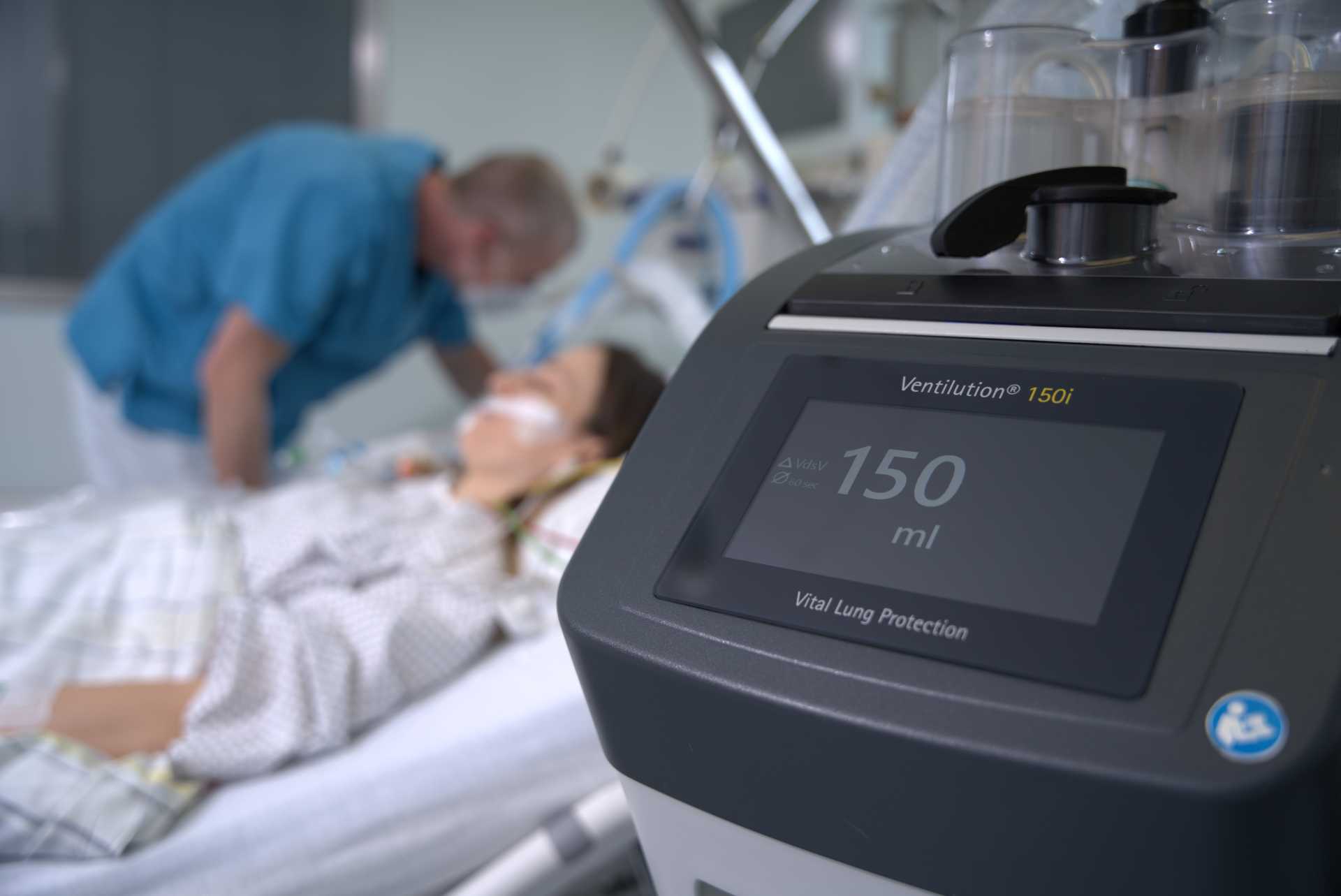
Conventional ventilators use a wide range of sensors to control and monitor pressure, humidity, gas, temperature and flow measurements during mechanical ventilation. Gründler medical Ventilution® is an innovative system for invasive ventilation designed to make treatment gentler for patients, thereby reducing mortality, ventilation duration and treatment costs.
For pressure measurement, Gründler relies on the AMS 5915 digital pressure sensor from AMSYS GmbH & Co. KG, and is already testing the AMS 5935 for a future generation of devices. In this interview, Markus Gründler, one of the managing directors, explains what matters to him when selecting pressure sensors for a medical device—and why collaboration with the sensor supplier is just as important as technical specifications.
1. Mr. Gründler, Ventilution was developed in response to a specific clinical challenge. What was the idea behind the system?
“Our starting point was the question of how to make mechanical ventilation as gentle as possible for patients. With Ventilution, we actively reduce functional dead space in the breathing circuit. Put simply, used breathing gas is replaced at exactly the right moment, reducing the proportion that is rebreathed. This allows ventilation pressure and volume to be reduced without compromising gas exchange. As a result, the lungs are protected and survival is improved. One of the key technical challenges is automatically identifying the correct timing for these processes. For such a method to work reliably in everyday clinical practice, the underlying technical processes must be extremely dependable and as automated as possible. This requires, among other things, suitable, high-performance sensor technology.“
2. What role does pressure measurement play in a system like this?
“Pressure is a key measured variable in pneumatic systems and ventilation technology. For us, it is essential to capture pressure profiles quickly and reliably and derive reproducible signals for controlling the system. The sensor’s nominal resolution and accuracy are not the only factors that matter. What is crucial is that the sensor remains stable under the device’s actual operating conditions and can be readily integrated into the electronics. Ventilution® uses various pressure sensors from the AMS 5915 series to cover different pressure ranges. In addition to ventilation pressure, we also measure ambient pressure and differential pressures, for example to determine volumetric flow rates.”
3. What criteria did you use to select the pressure sensor, and why did you choose the AMS 5915?
“Several factors were important to us during selection. The measurement ranges had to suit our application, and we wanted to use sensors from a single product family wherever possible for the different measurement tasks, keeping the control electronics and signal processing in our application software straightforward. At the same time, we needed good accuracy and reproducible readings. Simple digital connectivity and a package that could be reliably integrated into our electronics were also important. The AMS 5915 met these requirements extremely well. One advantage for us was that the sensor is already calibrated and temperature-compensated. The ceramic housing provides a high level of stability and reliability. Given the particular requirements of our system, we use sensors with very small pressure ranges—for example, to determine gas flow—as well as sensors with pressure ranges up to ±1 bar for measurements in high-pressure sections.”
4. How did the collaboration with AMSYS begin? Did you already know which sensor you wanted to use?
“No. At the beginning of a development project, we do not start by asking which sensor and part number to buy. Instead, we first look at the measurement task and its constraints. To find a good solution quickly and efficiently, it was—and still is—very helpful to have a dedicated contact with whom we can discuss specific requirements and possible solutions. At AMSYS, we had direct access to a technical contact right from the start. We were able to discuss our application and work together to identify the optimal sensor variant and suitable pressure ranges. That is far more valuable to us than simply being given a catalogue or a parametric search tool.”
5. What makes a good sensor supplier when developing a medical device?
“Naturally, the sensor must first be suitable and meet the necessary quality and technical specifications. But detailed questions always arise during development. What matters then is being able to reach someone quickly who understands the technology and works with the developer to find a solution. With pressure sensors in particular, many parameters interact: measurement range, differential or gauge pressure, resolution, temperature characteristics, mechanical connections, electrical interface and, of course, installation conditions. Moisture in the measured gases is another important issue in our application. Here, too, we were able to develop innovative approaches together with AMSYS. We therefore see real added value in technical advice. Our experience with AMSYS has been very positive. Collaboration has been exceptionally straightforward, and whenever technical questions arose, we could rely on a knowledgeable, dependable contact person—always the same person.”
6. You are now also testing the AMS 5935. What interests you about this newer sensor platform?
“When developing a successor product, we naturally also consider which components have become available in improved versions in the meantime and what additional possibilities they might offer our product. That is why we are currently testing the AMS 5935. We want to investigate the benefits the new platform could bring to a future device generation and how it performs under our actual operating conditions. We are particularly interested, for example, in the higher digital resolution (18-bit output), additional interface options and the availability of extremely small pressure ranges.”
7. Are Ventilution’s requirements highly specialized, or do developers of other medical devices face similar questions?
“Our specific application is indeed highly specialized because comparable technology has not previously been available on the market for intensive care ventilation. Nevertheless, many fundamental questions are similar in other medical technology developments. Whenever air or gas pressures or flows need to be measured, developers must consider the required measurement range, appropriate accuracy, measurement speed and how the sensor can be integrated mechanically and electronically.”
8. As you consider the next generation of Ventilution, would you work with AMSYS again for pressure sensing?
“We have worked with AMSYS for many years and value what competent technical support means to us—not only during the planning and design phase but also throughout the subsequent course of a project. We would therefore be very happy to work with AMSYS again on the next generation.”
The Ventilution® example also shows that selecting sensor technology involves more than comparing individual datasheet specifications. Pressure range, accuracy, interface, package design and integration into the overall system must all fit together. AMSYS supports developers in this selection process and offers customer-specific calibration in addition to standard products. The AMS 5915 covers a wide range of pressures, while the newer AMS 5935 platform is available particularly for very low to medium pressure ranges and energy-efficient applications.
The Company
AMSYS GmbH & Co. KG is a medium-sized company from Germany that has specialized in innovative solutions in the field of sensor technology since its founding. As a sensor technology distributor, AMSYS is one of the leading specialists in pressure measurement technology in German-speaking countries.
The AMSYS product range includes piezoresistive pressure sensing elements, SMD-mountable transducers, amplified and unamplified as well as calibrated OEM sensors, PCB modules, and ready-to-use pressure transmitters. With sensors and pressure sensing elements covering a pressure range from 25 Pa to 800 bar, AMSYS provides solutions for a wide variety of applications. In addition, the portfolio includes OEM humidity sensors, temperature and inclination sensors, as well as wireless solutions for diverse use cases.
Thanks to the technical expertise of its employees and close collaboration with suppliers, AMSYS also offers customer-specific adaptations of standard products, delivering tailored problem-solving solutions.